The Fourth Occurrence
An artist treasures his reclusiveness, but there are forces at work attempting to lure him into the fold.

I am an unlikely storyteller. Never in my life have I been accused of capturing anyone’s ear, not that I tried. I lacked the desire. I’m not fond of people and, when in the company of others, I find it impossible to disguise that sentiment. It’s not my aim to offend anyone, but neither do people take to me. Why would they? I give them no cause to, and certainly on rare occasions when someone, whether a neighbor, relative, or stranger, makes an attempt to draw me out, lays a sympathetic hand on my shoulder, offers guidance, expresses a desire to know my thoughts, to improve my outlook, my indifference to their charms dissuades them soon enough. Often it takes mere seconds though sometimes days before they abandon their efforts, but without exception I am soon free of their meddling and relieved of the prospective burden of fellowship.
I have my solitude, this is my consolation. I paint in my studio through the days and nights without fear of being disturbed or of the need to suspend my work for social commitments. In this, I feel fortunate. In another way, however, in a profound way, I am cursed. I have been pursued throughout my life by an insidious threat the avoidance of which consumes me. It is of this persecution that I write. If I succumb to this undefined menace, no one will miss me, and I must admit that vanishing in such a way seems fitting given my predisposition to reclusiveness, but what rankles me is my failure to learn who or what is behind these menacing encounters—attempted entrapments, more accurately—that have plagued me for all of my adult life.
That to which I refer manifested itself in three particular incidents occurring at eighteen-year intervals. I escaped all three occurrences intact, but if the schedule holds, a fourth is imminent, and if my reasoning is sound, I may this time be caught in their web before succeeding in unraveling the enigma. Fearing that my demise is inevitable, I write on the chance someone will work out the puzzle once I’m gone. While I may never know the answer, somehow the thought that someone may gives me, if not comfort, a modicum of gratification. If I can never know, at least I can see to it that the agents who hound me, tenaciously and methodically, may one day be found out. I can’t pretend to care about the execution of justice in a heightened sense or, practically speaking, for the safety of other innocent people. What gives me satisfaction is the notion that my reasoning may win out, or at least an extension thereof in the hands of another. Whoever these culprits are, I hope to outfox them, and if that happens once I pass on, to whatever realm that might be, it will be unfortunate but all in all welcome nevertheless.
⌾
I begin, then, with the first occurrence. On the seventeenth of July, 1958, I was a few weeks shy of eighteen. I’d been invited to Boston to attend a lecture entitled “Emblematic Figurativism: From El Greco to Gorky” at the Museum of Fine Arts by a recruiter from the college associated with that institution. My high school art teacher, a cousin of the recruiter, set up the connection for me with hopes I’d make an impression and be accepted into their painting and printmaking program. I believe my teacher, Miss Cloppens, was sincerely impressed with my work, but to expect I might sway the recruiter on the strength of my personal presence was foolishness. I had enough self-awareness even at that age to know it was a futile undertaking, and yet I rode the train up from Richmond out of curiosity. I’d seen only black and white reproductions of Gorky’s paintings and looked forward to the accompanying exhibition.
Regardless of the circumstances, on the afternoon before the lecture, I found myself in Boston on a steamy July day, strolling the shady side of Tremont Street with the aim of making my way to the Museum for an initial tour when I saw a large, awkward man in business attire on the sidewalk in front of a storefront. He held a clipboard to his chest, looking my way as if anticipating my arrival.
His smile widened as I approached. I don’t recall his opening line, how he hooked me into a conversation, but he identified me correctly as a prospective student and lured me into the unmarked establishment with the promise of sweet iced tea and “a map for my road to elevated accomplishment.” He introduced himself as Owen.
As I followed him inside I noticed how his hair sat oddly along his back collar. He was wearing a dark brown wig that, on closer examination, was composed of synthetic fibers and tailored too large for his scalp. His suit was overly full and the slacks too lengthy, even though the man was broad of frame and well over six feet in height.
The interior had the look of a retail shop that had been recently and perhaps hastily cleared of its fixtures. Left in the wake of the renovation were dusty blotches, ragged scratches, and careless paint smudges across the broad linoleum floor. A few rows of folding chairs took up part of the space. Two seats were occupied by inattentive young men, both staring expressionlessly ahead at a woman of indeterminate age stationed at a lectern. She too wore a brown, poorly fitting wig. She smiled at me, standing straight-backed.
Again, I got the impression this employee had been waiting for me. Nevertheless, Owen walked me past the chairs to a refreshment table in the corner of the room. As he poured my tea, I noticed the door leading to a back room was ajar. From beyond it I heard fluttering, a mechanical process of some kind I couldn’t identify.
Owen handed me a sweating glass of tea and asked something I remember to this day. “What would you say is the primary dynamic that drives your existence?”
I had no interest in addressing a question of that nature, nor would I have been able to form the words had I felt the need. I experienced at that moment a singular, sickening feeling, perhaps dread would best describe it, discomfort I would become familiar with in the decades to follow. It was a physical sensation, prickly skin along my outer arms and a nauseating sourness on my tongue. The malaise scattered my thoughts and sapped the firmness from my limbs.
Owen spoke on, addressing me by name, information I had not surrendered. There was some talk about an eternal spiritual being—he used a Greek word, I believe—a force exterior to us that occupies us, animates our bodies, and uses our minds. He offered a list of eight human “drives,” or urges, each encompassing the one before and therefore best pictured as a series of concentric circles. Each of the drives, he explained, exhibits itself in a different form in one’s life and yet all, in a primordial sense, are engendered by the animal need for survival. These drives range at the primal end from a desire to establish and protect oneself as an individual, to one’s yearning for belonging, to the urge to have sex, to be affiliated with larger, society-forming organizations, then on to more spiritual matters and, ultimately, one’s cosmic relationship with the universe. All eight drives he described in rapid succession with narrow-eyed focus and, taking advantage of my state, in effectively mesmerizing fashion.
I’d lost myself in the midst of his lecture, at some point apparently tipping my glass. Tea saturated my trouser leg and pooled by my right shoe. I recall staring at the mess, then turning for the door. It occurred to me later that, as per Owen’s world view, my most basic drive for self-preservation took hold. I fled.
In the weeks that followed, the encounter occupied my thoughts. I was perplexed and disturbed by it, but sought rationalization in the fact that I was new to city life and had been subjected to something wholly outside my understanding. My concern led, after time, to shame, not so much for my naivety, which I recognized, but for losing my composure. I’ve been childish, I thought. I’ll do better.
⌾ ⌾
The opportunity to handle such a situation in a more composed manner came in 1976, eighteen years later, nearly to the day, at a rundown municipal office a few blocks from my East Village cold water walkup in Manhattan. I’d received a notice through the mail, a citation for failing to register in person for New York City resident status, which seemed ludicrous. I’d been living in the city for twelve years and knew of no such requirement. Around noon a few days later, summons in hand, I entered an unmarked office building at the address indicated in the letter. Posted by the stairwell was a freshly printed sign directing “residents” to the third floor for processing, and on the third floor landing yet another sign pointing to a door, “3E”, down the hallway to the right.
Within was a modest office packed so closely with desks and filing cabinets that the entry door cleared the furniture by mere inches. I thought at that moment that it was my imagination, but it appeared the clerks, sitting at twelve desks in three rows of four, began busying themselves as I stepped inside. All had their eyes on their typing, forms, and files with the exception of a middle-aged woman at the extreme left side of the second row who stood at my appearance and directed me to take a narrow route around the periphery. As I made my way, I passed a poster taped to the wall bearing the bold slogan, “The Fourth: The Mankind Dynamic.” Pictured was a crowd of half naked people sitting in a concentric ring pattern.
The woman held her hand out for my summons as I took a seat by her desk. I was certain I’d seen her before but found nothing odd in that since she worked in the neighborhood. The dark wig should have been a tell, but it had been eighteen years since I’d passed her standing at the lectern, an image deep in my memory.
She pulled a set of forms from her desk drawer and commenced with the paperwork. “Let’s get started on the process, shall we?” she said. Her lower lip protruded unevenly on one side, effectively slurring her speech.
I asked if she could cite the regulation that required me to register for residency.
She paused and gave me a look that came off as concern for my welfare, as if I was perilously lacking in education. “You should think of this as an audit,” she said. Her eyebrows were shaved and penciled in arcs so wide they nearly met above the bridge of her thin nose. “Before we can grant you residency, a brief audit will be needed because only with that information can we map a precise route.”
“I’m sorry,” I said, “a route to where?”
She was rushing to complete the forms, X-ing out entire sections in her haste.
She stood. “The goal of auditing is to restore beingness and ability,” she said, then gestured for me to accompany her as she rounded her desk and turned for the back of the room.
It all felt unhinged, but not appreciably more than other bureaucratic nonsense I’d encountered in the city. We zigged around a bank of filing cabinets and entered a darkened room labeled, “Auditing in Progress.” I heard a projector clunk on as she ushered me to one of four chairs positioned in a single row before a small film screen. The introductory music groaned as the reels struggled up to speed. The opening credits faded up over a grainy pan of midtown Manhattan shot from a skyscraper window. “Finding Your Place With Clarity and Direction” read the title. A minute or so of wordless street scenes followed, shaky, candid, hand-held closeups of pedestrians, street merchants, and municipal workers. The music was unsuitable, a lilting waltz played on a squeaky accordion. The scene cut to a dismal point of view shot rolling through a subway tunnel upon which the words, “The accumulation of impedimenta,” were superimposed. With the dimmed scene, I noticed for the first time a set of legs in the corner, off to the right of the screen.
Shielding my eyes, I made out the standing figure, and with a cold wash of realization, the dread coursed through me. It was Owen, returning my stare.
The memories of Boston came back in a rush, and with them the bitter feeling of incompetence I’d suffered after the initial lecture from Owen. I subdued my impulse to escape and approached him.
He’d aged terribly. His face had grown paunchy, jowls heavier, eyelids sagging, but the pandering demeanor was intact and the wig unchanged.
“Just what is going on here, Owen?” I asked him. “What is this all about?”
He smiled, apparently pleased I remembered him. “We should take this opportunity to discuss auditing,” he said, and then described a process involving the “ridding of an individual’s spiritual disabilities” that was so extreme, logically deficient, and baffling in its phraseology that it enfeebled the objection I was preparing to make about having been summoned to the office under false pretenses.
Owen stepped closer, obstructing the throw of the projector. His face was slashed violently with images cast by the movie as he carried on with his mechanical recitation. I found my will sapping, much like my experience in Boston. It took great determination to interrupt him, to shake myself loose from the effects of his hypnotic cadence.
“I’m not disabled,” was the best I could manage.
“Your paintings of late are afflicted by your distress and the baggage you bear,” he said, reaching for my shoulder.
The sound of shuffling behind me stirred me to turn, but I snagged a foot on a chair leg and I pitched sideways. Stumbling, I pushed past the three workers who had entered and made my way out hearing behind me Owen’s plea to sit and take up the auditing process.
No one made an attempt to follow me. I considered reporting the ruse to city authorities, but I’d left my summons with the female clerk. I passed by the office the next day. The exterior door had been padlocked and newspaper masked the windows. No evidence remained.
Oddly, what chafed me most about Owen’s lecture and the incident was his critique of my paintings, which in no way reflect my inner life and certainly display no indication of conflict, encumbrances, or personal turmoil. My paintings are featureless. They’re soulless. I take no particular pride in this, nor do I apologize.
⌾ ⌾ ⌾
The pair of incidents, 1958 and 1976, were insufficient to demonstrate a pattern, but I had eighteen more years to ruminate. As each intervening year passed without a recurrence, I became more certain I’d need to be on guard when July of 1994 came around. To avoid a third incident, my strategy was to simply avoid contact. I stocked up with essentials and, as the anniversary approached, holed up in my studio, calling for a delivery only on one occasion when I needed first aid.
The pharmacy supplies became necessary after I overturned a metal work table onto my bare foot, this about a week into my self-imposed quarantine. I’d suffered a deep, ragged gash, and my efforts to treat it failed to prevent infection.
By the end of the third week, the wound site was swollen and oozing, and I felt feverish. I knew I needed medical attention. I judged that Owen and crew, wherever they might be lurking, had by that time surely lost patience and disbanded. I fashioned a cane from a canvas stretcher bar and hobbled to a clinic on Delancey.
I was unfamiliar with the facility, but I detected nothing out of the ordinary about the operation or its personnel. I followed the nurse’s instructions to undress, don a gown, and lay out on the exam table. I heard conversation in the hallway after which the nurse returned with two painkillers. She explained that the doctor would need to thoroughly flush and then suture the wound, which would necessarily be quite painful. It all seemed reasonable. I swallowed the pills. She told me to relax for fifteen minutes while the narcotic took effect.
Perhaps it will come as no shock to you that, when the doctor entered, I recognized him immediately as Owen, despite his greatly diminished state. Bowed at the shoulders and dragging what appeared to be a lifeless foot, he tented his white doctor’s jacket like a scarecrow. His face was gaunt, cheekbones protruding, lips drawn back from ill-fitting dentures.
I thrust myself to a sitting position. The room took a turn and I was on the floor, struggling to break the nurse’s grip on my upper arm.
I retain only snatches of detail from the next few hours—toppling over a coffee table in the waiting room, gazing up from the sidewalk at a gaggle of disobliging pedestrians, my face sticky with vomit on the back seat of a cab, the grumbling of my downstairs neighbor as he dragged me in off the stoop.
I awoke toward dawn the next day on my studio floor, scraped and battered, and with a more aggravated wound, but relieved to have, presumably, another eighteen year reprieve.
⌾ ⌾ ⌾ ⌾
As I write, it’s nearly daybreak on the 25th of July, 2012. I’ve fashioned a living area at one end of my Northern Brooklyn studio, not strictly legal in this commercially-zoned building, but it’s not the authorities I fear.
In these last few weeks, I’ve taken to sleeping from dawn to midday. At night, I hear inexplicable activity in the hallways and the occasional hushed talk, rambling, raspy, in an odd sense calm, though interrupted at times by a sharp cough that rings of a lifetime spent in unhealthy spaces.
Under my door, I see shadows pass, sometimes hovering. I hear labored breathing and a thump-scrape-thumping pattern I imagine as the gait of an elder torturously making his way, dragging his walker, the devoted one, the withering acolyte who over the decades has perhaps grown obsessed with the fine art of patient proceedings and yet no less determined to convert this reclusive, scornful, prideful artist.
For my part, I’m old enough now to wonder if my life of resolute independence, of willful self-neglect, has been worth it, if there would in fact be harm in submitting in these dark, weary years to an audit of my spiritual potential, to make use of what time I have left to clear my social disabilities, purge my unbearable memories, and ready myself for access to a higher plane where, just perhaps, there is peace beyond isolation, solace without loneliness, and no need to paint. ◼︎
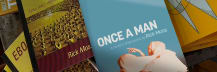
Rick’s latest novel, Once a Man, was released in February, 2026. It’s about a teenager who discovers he’s part of a plan to shape humanity’s relationship with superintelligent AI.
You can explore Rick’s artwork on his website…
© 2026 Rick Moss